
Unifying Fragmented Security Controls for CISOs
Table of Contents
- Why Fragmented Security Controls Break Down for CISOs
- Security Control Mapping: One Control, Many Requirements
- Building a NIST-Aligned Control Catalog as Your Foundation
- Continuous Compliance Automation: From Annual Audits to Always-On Assurance
- Security Evidence Management Without Duplicate Requests
- A Phased Roadmap for Unifying Security Controls
- Operating Model, Accountability, and Measuring What Matters
- Common Failure Modes and Trade-Offs to Plan For
- Frequently Asked Questions
Last Updated: October 12, 2026
Why Fragmented Security Controls Break Down for CISOs
Unifying fragmented security controls for CISOs means mapping every framework, regulation, and customer requirement onto one shared NIST-aligned control catalog, so a single action satisfies many obligations at once.
The core problem is not a lack of controls. It is that each framework gets treated as its own project: SOC 2 in one spreadsheet, ISO 27001 in another, HIPAA with a consultant, and privacy frameworks somewhere else entirely.
The Hidden Cost of Five Tools and Four Frameworks
Fragmentation shows up as time, not just risk. One control gets tested four times because four teams own four copies of it, and auditors ask for the same screenshot twice.
The real cost is visibility: when controls live in separate systems, no one can answer what actually protects the business right now or how residual risk is changing.
- Duplicate evidence requests burn staff hours every audit cycle
- Overlapping controls hide gaps because no one owns the whole picture
- New frameworks trigger a new project instead of a mapping exercise
Every new standard should be a mapping task onto your existing foundation, not a rebuild.
Security Control Mapping: One Control, Many Requirements
Security control mapping links a single control to every framework requirement it satisfies, turning four compliance projects into one control program. The goal is a unified control library where each entry points to all the standards it covers.
The mechanics are simple: start with your strongest framework as the backbone, then map everything else to it. Most teams pick NIST SP 800-53 because it is broad, well documented, and serves as the practical foundation for mapping SOC 2, ISO 27001, HIPAA, privacy frameworks, and customer-assurance requirements.
A Worked Example: Mapping AC-2 Across SOC 2, ISO 27001, and HIPAA
Take account management. One control, three frameworks:
- SOC 2 cares about access provisioning and removal
- ISO 27001 covers the same ground under access control clauses
- HIPAA requires access controls for systems holding protected health information
A single well-documented account management control (aligned to NIST SP 800-53 AC-2), with a clean evidence trail, can satisfy all three. The NIST SP 800-53 control catalog is the practical starting point for this kind of mapping.
Building a NIST-Aligned Control Catalog as Your Foundation
A NIST-aligned control catalog is your single source of truth: one list of controls, each mapped to every framework, regulation, and customer requirement it satisfies. Build it once, and every future framework becomes a mapping exercise rather than a new project.
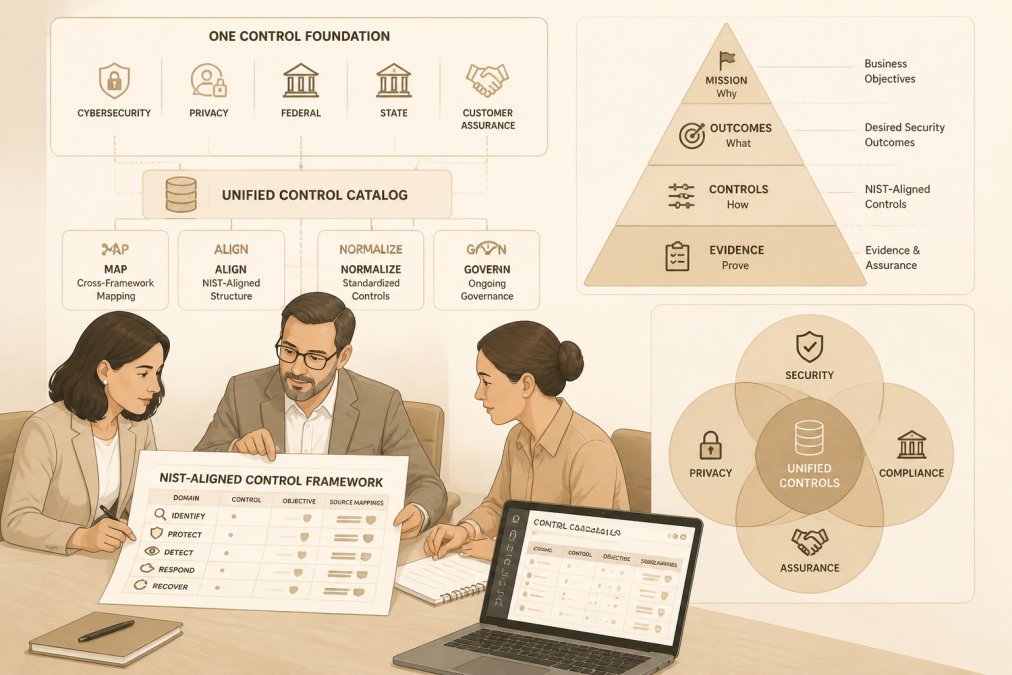
Team reviewing a NIST-aligned control catalog for unifying fragmented security controls for CISO’s
Start with what you already have. Most organizations are closer than they think.
- Pull every existing control from current tools and spreadsheets
- Group duplicates under one canonical control name
- Tag each control with the frameworks it serves (SOC 2, ISO 27001, HIPAA, privacy, federal/state, customer questionnaires)
The catalog need not be perfect on day one. It needs to be the place everyone updates.
NorthStar Intelligence Portal is built on this exact model—a shared NIST SP 800-53 control foundation with NIST CSF 2.0 as the organizing structure—so cybersecurity, privacy, federal, state, and customer requirements map onto one catalog instead of becoming separate workstreams.
Continuous Compliance Automation: From Annual Audits to Always-On Assurance
Continuous compliance automation tests controls on a schedule instead of once a year, replacing the annual fire drill with ongoing checks that catch drift early.
A common mistake is automating before you have a clean catalog. You end up automating the wrong controls, faster.
- Automated checks run on a fixed cadence, not a panic timeline
- Failures surface as work items tied to risk and remediation, not audit surprises
- Evidence collects itself as a byproduct of normal operations
The NIST Cybersecurity Framework frames this as continuous monitoring across Govern, Identify, Protect, Detect, Respond, and Recover. It maps well to how auditors and customers now expect programs to run—always-on assurance rather than point-in-time snapshots.
Security Evidence Management Without Duplicate Requests
Security evidence management means collecting proof once and reusing it across every audit, questionnaire, and framework that needs it. Duplicate evidence requests are the clearest symptom of a fragmented program.
Fix the root cause: when evidence ties to a control in your NIST-aligned catalog, one collection serves every framework mapped to that control.
Platforms that connect evidence directly to controls, risk, and reporting eliminate this cycle of rework.
A Phased Roadmap for Unifying Security Controls
A phased roadmap beats a big-bang migration. The version most teams run has four phases, because inventory and integration each hide a second job: rationalizing what you found, and proving the integration works. Give every phase a named executive owner, entry and exit criteria, and a board-visible milestone.
Sequencing rule: never start a phase until the prior phase’s exit criterion is met. Teams that run phases in parallel usually rebuild the catalog twice.
Phase 1: Inventory and Rationalize What You Already Own
A phased roadmap beats a big-bang migration. The version most teams run has four phases, because inventory and integration each hide a second job: rationalizing what you found, and proving the integration works. Give every phase a named executive owner, entry and exit criteria, and a board-visible milestone.
Sequencing rule: never start a phase until the prior phase’s exit criterion is met. Teams that run phases in parallel usually rebuild the catalog twice.
Phase 1: Inventory and Rationalize What You Already Own
Inventory first: list every control, tool, framework, and customer requirement in play, then merge duplicates. This unglamorous phase decides whether the rest works.
- Build a control inventory from every current source: GRC platform, spreadsheets, ticketing systems, cloud consoles, vendor questionnaires, and prior audit workpapers
- Normalize control names to a single vocabulary before merging (“access review” and “user access recertification” are the same control)
- Merge duplicate controls into single canonical entries and record every framework requirement each one satisfies
Entry criterion: executive sponsor named and scope agreed.
Exit criterion: a unified control catalog with one owner per control and a documented mapping to every in-scope framework.
Typical duration: 4–8 weeks for a mid-size program.
Milestone: catalog signed off by the CISO and the compliance lead.
Change management matters most here: teams who built the old spreadsheets will resist losing them, so bring them into the merge as reviewers, not subjects.
Phase 2: Assign Ownership and Rationalize the Control Set
Ownership is a separate phase because it is a separate failure mode. A catalog with no owners drifts within a quarter.
- Publish a RACI for each control: one accountable owner, plus responsible, consulted, and informed parties across security, IT, compliance, and the business
- Resolve conflicts where two teams both claim ownership
- Identify gaps where a framework requirement maps to no control, and either build the control or document the accepted risk
Entry criterion: signed-off catalog from Phase 1.
Exit criterion: every control has a named accountable owner and a documented RACI.
Typical duration: 3–6 weeks.
Milestone: ownership map published and acknowledged by each accountable owner.
Phase 3: Integrate, Automate, and Connect Evidence
Integration comes third: connect your tools so data flows into the catalog, then automate testing and evidence collection on top of the validated mapping.
- Connect the platform to identity, cloud, vulnerability, and ticketing systems so control status updates without manual entry
- Automate evidence collection as a byproduct of normal operations
- Automate control testing on a fixed cadence, with failures routed as work items rather than audit findings
Entry criterion: ownership map complete.
Exit criterion: at least the highest-risk controls have automated testing and evidence tied to catalog entries.
Typical duration: 8–16 weeks.
Milestone: first audit or customer questionnaire answered from the catalog without a manual evidence scramble.
Phase 4: Measure, Refine, and Hold the Line
Measurement is the phase most teams skip, and the one that keeps the program from fragmenting again.
- Baseline the metrics before you claim improvement: duplicate-control count, evidence cycle time, test coverage, mean time to remediate, and frameworks satisfied per control
- Review the catalog quarterly and retire controls that no longer map to anything live
- Apply strict change control when a new framework arrives—it should be a mapping exercise, not a new project
Phase | Focus | Typical Duration | Key Output | Executive Owner |
|---|---|---|---|---|
Phase 1 | Inventory and rationalize | 4-8 weeks | Unified control catalog | CISO |
Phase 2 | Ownership and RACI | 3-6 weeks | Named owner per control | CISO with compliance lead |
Phase 3 | Integrate and automate | 8-16 weeks | Automated testing and evidence | Security engineering lead |
Phase 4 | Measure and refine | Continuous | Posture visibility and reporting | CISO |
Operating Model, Accountability, and Measuring What Matters
Accountability keeps a unified program from drifting back into fragments. Every control needs one named accountable owner, even when many teams contribute. Shared ownership without a name is how gaps form.
A RACI-Style Model for Control Ownership
The operating model that survives contact with reality separates four roles for every control:
- Accountable: one named person who answers for the control’s design and operating effectiveness
- Responsible: the team that performs the control activity day to day
- Consulted: compliance, legal, privacy, and business stakeholders whose requirements the control satisfies
- Informed: stakeholders who need visibility but do not own the outcome
A common pattern: the CISO is accountable for the control program, security engineering for technical controls, IT operations for infrastructure controls, and business unit leaders for controls inside their processes. Compliance is consulted on mapping and informed on status, not accountable for whether the control works. That distinction is where most programs go wrong.
Outcome Metrics with Baselines
Measure outcomes, not activity. The metrics that matter to a board show whether fragmentation is shrinking. Baseline each one before you start, or you cannot prove the program worked.
- Duplicate-control reduction: count controls that map to more than one framework before and after rationalization. A common target is cutting the control count by a third without losing coverage.
- Frameworks satisfied per control: the average number of frameworks each canonical control maps to. Rising numbers mean the catalog is doing its job.
- Evidence cycle time: elapsed time from evidence request to evidence delivered. Teams that unify controls often cut this from weeks to days.
Set targets with your steering committee, not in isolation. A target without an owner is a wish.
Reporting That Comes from Live Data
Board reporting should be a view, not a project. When controls, risk, remediation, and evidence share one data model, posture reporting pulls from live status instead of a quarterly rebuild.
NorthStar Intelligence Portal connects requirements, controls, risk, remediation, and evidence into one operating view, so the quarterly report becomes a filter rather than a fresh spreadsheet. The measure of a unified control program is simple: how many frameworks does one control now satisfy, and how much duplicate work did that remove?
Common Failure Modes and Trade-Offs to Plan For
The most common failure is mapping without rationalizing: teams link controls to frameworks but never merge duplicates, so fragmentation survives inside the new tool.
Other trade-offs worth planning for:
- Consolidation reduces flexibility for teams that like their own tools
- A single catalog creates a single point of failure if governance slips
- Automation hides bad controls if the underlying mapping is wrong
The AICPA SOC 2 trust services criteria remain a common benchmark for customer assurance, and a clean NIST-aligned catalog makes meeting them repeatable rather than annual.
Most security leaders know their controls are fragmented. The hard part is committing to one foundation and holding the line as new frameworks arrive. When requirements, controls, risk, remediation, and evidence live in one connected system, continuous assurance becomes practical instead of aspirational.
Request a demo to see how a NIST-aligned control foundation eliminates duplicate work and gives leadership a live view of security posture.
Frequently Asked Questions
What does it mean to unify fragmented security controls?
Unifying fragmented security controls means mapping every framework you must satisfy, such as SOC 2, ISO 27001, HIPAA, and state privacy laws, onto one shared control library instead of running separate projects for each. When controls are unified, a single access-review control satisfies multiple requirements at once. The result is fewer duplicate assessments, one evidence set, and a clear view of what applies to your organization and where you stand against it.
How do you map one security control to multiple compliance requirements?
Start with a NIST-aligned control catalog, then build a crosswalk that links each of your controls to the specific requirements it satisfies. For example, an account-management control can map to SOC 2 access provisions, ISO 27001 access control clauses, and HIPAA access safeguards simultaneously. Security control mapping tools store these relationships so that when a requirement changes, you see exactly which controls and evidence are affected without rebuilding the crosswalk by hand.
What is the difference between security control consolidation and compliance automation?
Consolidation is the structural work: reducing overlapping controls into one unified library and mapping them across frameworks. Compliance automation is the ongoing work: continuous monitoring, automated evidence collection, and control testing that runs against that library. You need consolidation first, because automating fragmented controls just produces faster fragmentation. Together they turn compliance into a byproduct of a well-run security program rather than a series of separate audit scrambles.
How can organizations reduce duplicate evidence collection?
Collect evidence once and attach it to the control, not the framework. When security evidence management is centralized, a single screenshot of your access-review process can satisfy auditors for SOC 2, ISO 27001, and HIPAA at the same time. Set evidence to expire on a schedule, automate collection where systems allow it, and route every request through one queue. Teams typically cut the hours spent chasing screenshots and spreadsheets before each audit.